Rap Joint Lagos

2024! 12 Nigerian Rappers to Watch

Nigeria has long been a hotbed of musical talent, especially in the realm of hip- hop. As we enter 2024, the Nigerian rap scene continues to evolve, with a diverse array of artists making waves both locally and internationally. Here are twelve Nigerian rappers to keep an eye on this year: 1. Tobe Nwigwe Tobe Nwigwe, with his distinctive style and thought-provoking lyricism, has been steadily gaining recognition. Known for his soulful beats and conscious rhymes, Tobe’s music is a powerful blend of storytelling and introspection. Tobechukwu Dubem “Tobe” Nwigwe (born March 8, 1987) is an American rapper, singer and actor. As of 2022, Nwigwe co-stars in the Netflix television series Mo and received a nomination for Best New Artist at the 65th Grammy Awards. Nwigwe has collaborated with many other artists, including Pharrell Williams, D Smoke, Black Thought, Royce Da 5’9″ and Nas. Nwigwe’s The Pandemic Project was released in 2020. As he continues to explore new sonic territories, he is poised to make an even greater impact on the global hip-hop stage in 2024. https://www.tobenwigwe.com/ https://www.instagram.com/tobenwigwe/?hl=en 2. Lil Simz: While Lil Simz hails from the UK, her Nigerian roots are evident in her music, blending influences from both worlds. Simz has been a force in the industry, garnering critical acclaim for her intricate wordplay and dynamic flow. Simbiatu “Simbi” Abisola Abiola Ajikawo (born 23 February 1994),better known by her stage name Little Simz, is a rapper, singer and actress. She rose to prominence with the independent release of her first three albums; A Curious Tale of Trials + Persons (2015), Stillness in Wonderland (2016) and Grey Area (2019), the last of which was shortlisted for the Mercury Prize and won the awards for Best Album at both the Ivor Novello Awards and the NME Awards. We Expect her to maintain her upward trajectory and make more significant contributions to the rap landscape this year. https://littlesimz.com/ https://www.instagram.com/littlesimz/?hl=en 3. Wale: Wale, a seasoned artist with a career spanning over a decade, remains a prominent figure in NigerianAmerican rap. Known for his clever wordplay and ability to switch between various styles, Wale continues to be a trendsetter. Olubowale Victor Akintimehin (born September 21, 1984), better known by his stage name Wale ,first gained recognition in 2006 when his song “Dig Dug (Shake It)” became popular in his hometown of Washington D.C., leading to Wale gaining local recognition as he continued recording music for the regional audience. In 2008, a three-label bidding war resulted in Wale signing with Interscope Records for US$1.3 million, releasing his debut studio album Attention Deficit in November of the following year. The album was under-shipped and underperformed commercially, but was met with positive reception and marked Wale’s first Billboard Hot 100 entry with its lead single, “Chillin” (featuring Lady Gaga). In 2024, anticipate Wale’s continued impact as he navigates the everchanging rap landscape. https://www.walemusic.com/ https://www.instagram.com/wale/?hl=en 4. Skepta: Skepta, a grime artist with Nigerian heritage, has successfully bridged the gap between the UK and Nigerian music scenes. Renowned for his energetic performances and razor-sharp lyricism, Skepta remains a key figure in the global hip-hop community. Joseph Olaitan Adenuga Jr. (born 19 September 1982), known professionally as Skepta, is a British grime MC, rapper, record producer and DJ. Skepta released his debut studio album Greatest Hits in 2007 and his second album, Microphone Champion in 2009, both independently; while his third studio album Doin’ It Again was released in 2011 by AATW. Keep an eye on him as he explores new collaborations and pushes the boundaries of the hiphop genre. https://helloskepta.co.uk/ https://www.instagram.com/skepta/?hl=en 5. Tion Wayne: Tion Wayne has been making waves with his infectious beats and catchy hooks. As a versatile artist who effortlessly blends Afrobeat and rap elements, Tion Wayne has caught the attention of fans worldwide. Dennis Junior Odunwo (born 1 September 1993), known professionally as Tion Wayne, is a Nigerian-British rapper and DJ from Edmonton, North London. He appeared on three top-10 singles on UK Singles Chart as a guest – NSG’s “Options”, “Keisha & Becky” with Russ Millions and KSI’s track “Houdini” – before getting his first top 10 hit as the lead artist with “I Dunno” featuring Dutchavelli and Stormzy, which peaked at number 7, and having his first number 1 with “Body” alongside Russ Millions. With his charismatic presence and evolving sound, he is undoubtedly one to watch in 2024. https://www.tionwayne.co.uk/ https://www.instagram.com/tionwayne/?hl=en 6. Illbliss: Illbliss, also known as “Oga Boss,” stands as a unique figure in the Nigerian rap scene, epitomizing the rich cultural diversity of the country. What sets him apart is his mastery of trilingual rap, seamlessly incorporating English, Igbo, and Yoruba into his lyrics. This linguistic versatility not only adds depth to his music but also reflects the multicultural tapestry of Nigeria. Beyond his musical prowess, Illbliss has made significant strides in the entertainment industry, showcasing his acting skills in roles like Odogwu in the acclaimed movie “King of Boys.” This dual proficiency in both rap and acting allows him to contribute to the narrative of Nigerian culture on multiple fronts, solidifying his status as a multifaceted artist. Moreover, Illbliss has demonstrated a keen understanding of the Lagos Hip-Hop economy. By staying attuned to the pulse of the city’s vibrant music scene, he actively shapes and contributes to the evolution of Lagos as a hip-hop hub. Through his involvement, Illbliss not only uplifts his own career but also paves the way for emerging talents, fostering a dynamic and thriving hip-hop community. https://en.wikipedia.org/wiki/Illbliss https://www.instagram.com/illblissgoretti/ 7. Olamide: Olamide, often referred to as the “King of the Streets,” has consistently delivered hits that resonate with a wide audience. With his unique blend of Yoruba and English lyrics, Olamide’s influence is set to persist, contributing to the vibrancy of Nigerian rap. Olamide’s recent Grammy nomination is a testament to his enduring impact and the global recognition of Nigerian hip-hop. The nomination not only underscores his talent but also signifies a significant milestone for the entire Nigerian music industry.’ 8. MI Abaga: MI Abaga,

2024! 12 Nigerian Rappers to Watch Read More »
Hip-Hop and Politics: The US Presidential Elections

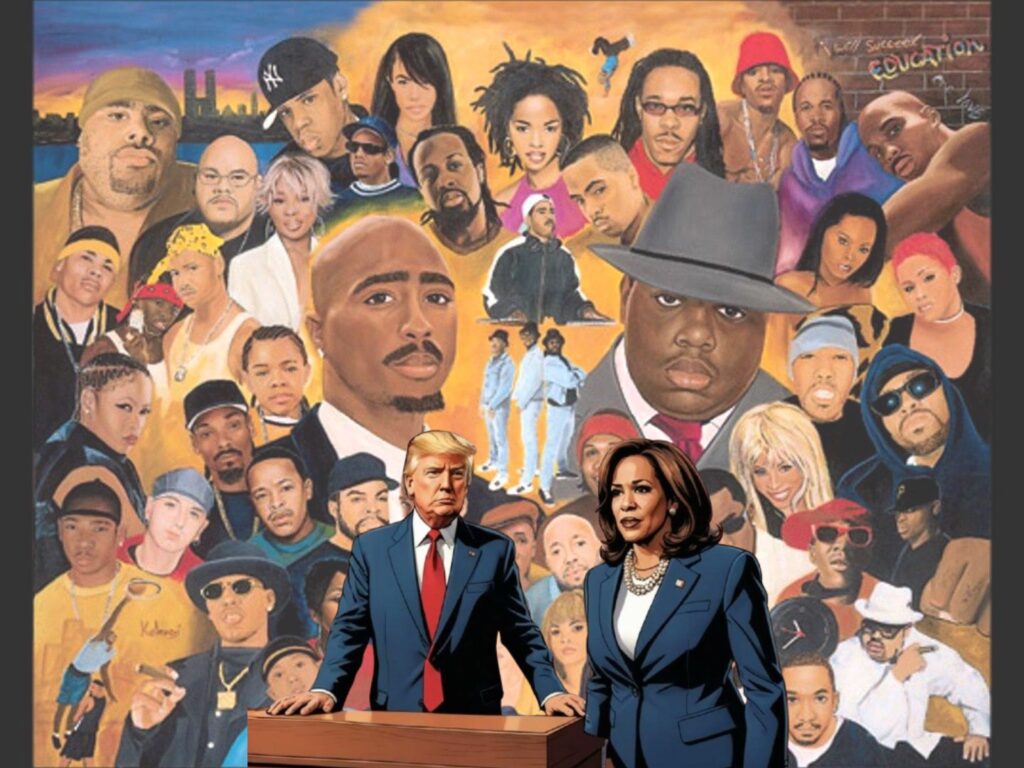
The involvement of Hip-Hop in politics is no longer news. However, Hip-Hop’s involvement in the 2024 US Presidential elections appears to be the biggest after Jeezy of Atlanta and the legendary Nas proclaimed, “My president is Black!” during candidate Barack Obama’s 2008 presidential run. The historic election of the first Black president went beyond politics. It birthed the election of the first hip-hop president. Hip-Hop culture became a vessel for social impact through politics.  Jay-Z campaigned for Obama in 2012 and was a frequent White House guest with Beyoncé, who sang the national anthem at Obama’s second inauguration in 2013. They also stumped for presidential candidate Hillary Clinton during her own historic 2016 run. As for Harris, she has the backing of a strikingly diverse group of hip-hop artists and producers, such as Eminem, Will.Iam, Questlove, Common, Fat Joe, J.Lo, MC Lyte, Cardi B, Beyoncé, Lil Nas X, Lil Jon, and Plies. Eminem introduced Obama in his hometown ,Detroit,  at Harris’ campaign and Obama returned the favour by rapping “Lose Yourself” by the former. Trump seemed to prefer coming onstage to “Many Men” by 50Cent for some of his campaign after the attempted assassination. 50 Cent claimed to have turned down a $3m offer to perform at his campaign.  And, it’s not one sided. Recently, rapper and criminal justice reform advocate Meek Mill challenged Kamala Harris’ record during her terms as district attorney of San Francisco from 2004 to 2011. “I wanna ask Kamala Harris questions about her past as a DA, even if she had to be tough. All I hear is rumors of her,” the 37-year-old rapper posted on X, formerly known as Twitter. “I would ask her 3 questions about black and brown men going to prison and her views and try to help her understand from a survival standpoint point she may have never had to encounter!” The Facebook post that said Harris placed 1,500 Black men behind bars over marijuana charges as district attorney has been reportedly debunked. It is reported that Harris actually oversaw 1,956 felony marijuana convictions. Only 45 people were sent to state prison. Nonetheless, the issue has emboldened some hip-hop artists’ support for former president Donald Trump. Lil Pump, Waka Flocka Flame, Lil Wayne, Kanye West, and Sheff Gare are some of the rappers who have publicly backed the Republican candidate. Sexyy Redd received backlash after she told podcast host Theo Von in October 2023 that some Black people embraced Trump “once he started getting Black people out of jail and giving people that free money.”  “We love Trump,” Sexyy Redd said. “We need him back in office. We need him back because, baby, them checks. Them stimulus checks. Trump, we miss you.” As documented in the Andscape film “Hip-Hop and the White House”, this unlikely political connection go way back to President Ronald Reagan’s 1985 inaugural ball, where legendary actor Jimmy Stewart introduced a performance by the storied New York City Breakers crew. Ironically, it was Reagan’s devastating policies targeting the Black and Latino community that accelerated Hip-Hop’s growth as the decade’s most vital musical and cultural art form. “Too Short, Ice-T, Toddy Tee, Public Enemy,” Hip-Hop and the White House’s executive producer and narrator Jeezy said. “Those are just a few rappers who reveal what Reagan’s so-called war on drugs did to the places where hip-hop lived.” In Nigeria,  Tuface, Falz, Mi, and some other rappers have continuously stood up for social change through political activism and their lyrics.  One thing is clear, regardless of the outcome of the election: Hip-Hop culture matters in politics and in shaping government policies towards the youth demography in the US.  Hip-Hop’s cousin, Afrobeats, has similar potential in Nigeria. We are watching.  References: “Andscape: Kamala Harris Gets her Hip-Hop Close up”: https://andscape.com/features/kamala-harris-gets-her-hip-hop-close-up/ Washington Times-“Foul Mouthed Rappers Supporting Kamala Harris”:  XXL Magazine-Rappers Supporting Vice President Kamala Harris : https://www.xxlmag.com/rappers-supporting-vice-president-kamala-harris/ Pulse.ng-“Falz and 4 other Nigerian Celebrities Who are Political Activists: 

Hip-Hop and Politics: The US Presidential Elections Read More »

Album Review: Vector’s “Teslim: A Lover Boy’s PTSD”

The title of the latest Album (and 6th studio album) by Lafiaji Lagos born & bred, Hip-Hop Legend, Vector (Olanrewaju Ogunmekan), has a refreshing shock and disturbing factor. One wonders the basis of “PTSD” (Post Traumatic Stress Disorder) in the title of a Hip-Hop album? ‘What can fa ?’ (what’s the issue?) Rappers are meant to be tough guys. They are not supposed to be traumatized and stressed. At least they are not meant to exhibit it, abi? Conversely, the title speaks volume of the theme of the album: the irony of romantic love. The bitter sweet nature. According to Vector: “it’s for the ladies”. The album is the  antithesis of the often criticized macho and misogynist leaning of Hip-Hop. It is also groundbreaking in that it is a full album on the concept of love. You often find a few tracks on a rap album on the idea, if any. This is a whole album.  Vector is a songwriter, MC, singer and philosopher. This is his 6th studio album. Other works include “State of Suprise(2010), The Second Coming (2012), Lafiaji (2016), “Vibes Before Teslim: A Journey to Self-Discovery (2019) and “Teslim: The Energy Still Lives in Me (2022). A battle rapper per excellence, who many believed won the celebrated rap battle with Mi Abaga in  2019. He has consistently won awards for his work from 2012. He is widely rated as top 5 Nigerian rapper, dead or alive.  “Teslim: A Lover Boy’s PTSD”’s language is quintessentially Lagos: English, broken, Yoruba and street slangs. Multi-lingual. Only a few Hip-Hop legends thread this path. Lord of Ajasa, Dagrin, Olamide, Foxy Brown, Nicki Minaj and a few others. Vector also tried French on “Fefe”. The track with Ivorian artist Shado and French Rapper, Scridge.  This body of work is not dense or unnecessarily long. It is accessible to the soulful/R & B crowd as well. It is a 10 track album. 34 minutes. An average of 3.40 sec per track. It reminds one of the greatest Hip-Hop album “Illmatic” for brevity. It takes a lot not to pander to the TikTok  era demands for 1-2minutes tracks.  It feature tight collaborations with Tiwa Savage on “Repay Your Part”; Falz “Bum Bum of my Heart”; Top Adlerman, Emmsong & Jossman on rap, highlife and reggae inspired “My Dada”; Niniola on “Iya Nla Iya”; and, Ivorian Shado Chris & French rapper Scridge on “Fefe”. One could hear the fusion of R & B, highlife sound, reggae and other genres on the album.  However, I have a bias against having more than one to two tracks with other artists by MCs (as against rappers) on albums. An MC is usually a songwriter, lyricist, and rapper. Whilst, rapper is usually someone that can rap and not necessarily a songwriter or lyricist. In my opinion, 1-2 features  on an album by an MC is an emphatic statement of intent and confidence to create a timeless album. A classic.  Though “Teslim: A Lover Boy’s PTSD” is an exception to my bias. All the tracks are bangers with diverse value to the work; and not fillers. I would not sacrifice any of the tracks for my bias.  With catchy hooks and lyricism at its finest throughout the tracks, the album is easy to listen to. The lyrics are funny and serious at the same time.  For example,  on “Repay Your Part” with Tiwa Savage,  Vector rapped “strong head/ coconut type, when you compare/Yoruba charm. Demons yes. Angels yes/Eni ti olo ko so/it’s a 2 seater ride ko mo o”. Tiwa Savage was not left out, she went in “Make nobody come stress my life/my love is easy: kogbagidi, kogbagidi, kogbagidi/ I am a sweet pot but mo lagidi like a colorful graffiti”.  The work also appears to celebrate African sound for Hip-Hop, which is projected to be the future for the culture.  Is this a classic album? Time would tell-it’s a discussion that can’t be fairly had before 10years. The album must endure. People must be able to go back to it without prompting. But it has the capacity to endure and be a classic album.  It is a respectable work by a fellow Lagosian.

Album Review: Vector’s “Teslim: A Lover Boy’s PTSD” Read More »

Dr. Dre is the Best – Rap Joint Lagos

Andre Romelle Young known professionally as Dr. Dre is considered the most commercially successful hip hop personality of all time influencing both hip hop and mainstream culture throughout his over 30 year career. Considered the first rap personality to make a billion dollars, his influence comes from work as a rapper, a producer, a record label and entertainment executive, an entrepreneur, and an actor. Born 18 February 1965, Dre grew up in Compton, and was primarily raised by his grandmother as his family moved quite a bit, while he was attending suburban Roosevelt high school away from the gang violence of Compton. Dre’s parents were separated early on in his life and his mother, Verna Young was once remarried to Warren Griffin, father of Warren G. Making Warren G Dre’s step brother. Dr. Dre didn’t excel in high school and mostly had poor grades requiring him to move from school to school. At one point he tried to apprentice for an aviation company, but was rejected due to poor grades. This failure in schooling created space for the young Dre’s other interests, most specifically music. In 1985, Dr. Dre began his music career as a member of the World Class Wreckin’ Cru, and later found fame with the gangsta rap group N.W.A. In 1984, Dr. Dre got very interested in DJing after spending a lot of time at “Eve after dark”, a club in Compton. Fascinated by Grandmaster flash’s club banger, “The adventures of grandmaster flash on the wheels of steel”, young Dre would go to the club to watch rappers and DJs doing their thing live. This exposure would lead him to make his first music moves, and he quickly became a resident DJ at Eve, going by the name Dr. J in honour of his favorite basketball player, Julius Erving, a hall of fame legend, who popularized the basketball in America during his time as forward for the New York Nets and Philadelphia 76ers. The legend won 3 championships during his career and 4 most valuable player awards. He went by the nickname Dr. J. This kind of success and excellence was a strong influence on young Dre, who quickly adopted the nickname of his idol as he began his early music explorations at Eve. Eve would prove a great training ground for the young upstart, giving birth to Dr. Dre. Young Dre quickly developed confidence in his craft, and dubbed himself “Master of Mixology”. This new found confidence led him to create a name that was all his — Dr. Dre, leaving behind the J from his hero in favor of his own name, but retaining the title Dr. to assert his prowess in music. At Eve after Dark, Dr. Dre met aspiring rapper Antoine Carraby, who would later become fellow NWA group mate DJ Yella. The two began collaborating, recording the song “Surgery” in the back room studio of Eve. Following the track’s success on the west coast hip hop scene, the duo were invited by founder of Eve, Alonzo Williams to join his electro hop music group, “World Class Wreckin’ Cru”. Williams later created a label, The Cru, to release the group’s music, and “Surgery” was the second single released by the label, followed by a full length album, “World Class”. The album’s success led to a deal with CBS records, who requested more acts from the Cru, so the young Dr. Dre brought in his cousin’s group CIA, whose member Ice Cube would later become a member of NWA. The CBS deal gave “World class” bigger distribution and ultimately built a base of fans for the group and its individual members on the underground west coast music scene. By 1987, this new found success led Dre to drop out of high school; but at his mother’s insistence that he get a job and continue his education, Dre briefly attended radio broadcasting school. Ultimately he would forgo school completely to focus full time on his DJ gig at Eve After Dark. Around the same time, Dr. Dre also began working on side projects, producing in the Cru’s studio at Eve. Most notably Dre produced for local entrepreneur Eazy E’s “Ruthless Records”. As Dre became successful, he also started to get into trouble, racking up traffic violations and refusing to settle them. Alonzo Williams would typically post Dre’s bail, but after a third violation he refused. In exchange for production work on Ruthless Records, Eazy E paid Dr. Dre’s traffic violation bail. Throughout his career Dre would frequently get in trouble with the law. In August 1994, shortly after winning his Grammy for best rap solo, “Let me ride”, he was sentenced to 8 months in jail for drunk driving. Prior to that, he was convicted for battery after breaking a man’s jaw outside his girlfriend’s home in 1993. Dre began working more with Eazy-E through his Ruthless Records and he would begin collaborating with O’Shea Jackson, known popularly as Ice Cube. These relationships led to the formation of NWA, which stands for Niggas With Attitude, by Eazy-E. Together with fellow producer Arabian Prince, and long time collaborator DJ Yella, NWA was off to a promising start. In 1987 Ruthless Records dropped the compilation album NWA and the Posse with the hit single “Panic Zone”, a track originally written by Mexican Rapper Krazy-Dee as “Hispanic Zone”, but changed to Panic because Dr. Dre understood that the word “Hispanic” wouldn’t help sales. For most of the 1980s, New York city, where hip hop originated was the dominant rap scene. Los Angeles was on the come up around the time with “dance party”, “electro rap” and “funk hop” as dominant styles popularized by DJs. In the early days of hip hop, the DJ was king, setting the beat over which rappers would spit their verses. By 1984, the MC became the focal point when Run-DMC dropped their break out album “Run-DMC”; the album presented a tougher more hardcore side to hip hop. Ice T would take this

Dr. Dre is the Best – Rap Joint Lagos Read More »

A short history of Hip-hop

Hip hop began in New York City in the 1970s. Found by African Americans, Latino Americans, and Carribean Americans in the streets of the Bronx, the formalization as a movement beyond music was set forth by Afrika Bambaataa, founder of hip hop collective, Zulu Nation. He outlined four core principles of hip hop: Rapping, DJing, Breakdancing, and Graffiti. These core principles are the defining forces in the music and cultural street style of hip hop.  Afrika Bambaataa was not the first person to spin records or write graffiti, or to celebrate emceeing or b-voting, but these four elements coalesced under his aegis when he started throwing hiphop parties. Writers have often, conveniently, credited the origin of Hiphop to a holy trinity founders: Afrika Bombaataa, Clive “DJ Kool Herc” Campbell, and Joseph “Grandmaster Flash” Sadler.  However, the origin and influence of Hiphop was wider. Hiphop has a strong West Africa influence and lineage. It’s lineage may be traced to the Griots in Senegal, who have engaged in spoken-word story telling for ages. Also, there is strong influence from Fela’s music, which Afrika Bombaataa discovered on a trip to Africa. Subsequently, he would play music he found in Africa particularly Fela and King Sunny Ade during Hiphop at his shows. It can be inferred that he discovered Fela’s music in Lagos being the afrobeat Legend’s base.  Others with a claim to the foundation of Hiphop includes Brooklyn Grandmaster Flowers, disco group the fat Fatback Band, jazz poet Gil Scott-Heron, smooth talking mid century radio personalities like Frankie Crocker and Jocko Henderson, swaggering rhymester Muhammed Alia and jazz legend Louis Armstrong. Rap wasn’t officially recorded till 1979.The genre grew behind the scenes through block parties in much of the 70s, where DJs played percussive breaks of popular songs using two turntables; and then EmCees would rap in a chanting vocal style, over the DJ beats. The first track to gain mainstream popularity was “Rapper’s Delight” by The Sugarhill Gang.  The 1980s were a real break out point for hip hop. Kurtis Blow dropped the single “The breaks” in 1980 and the track became the first rap song certified gold. In the years following, many acts would release genre defining hits, including 1982’s “The Message” by Grandmaster Flash and the Furious Five and Afrika Bambaataa’s “Planet Rock”. Also notable is the socially conscious statement, “It’s like that”, by Run-DMC. Audiences and artists alike would embrace the core principles defined by Bambaataa, with minority groups fully embodying the culture in urban centers through the music, breakdancing and graffiti in the streets. The fluid intersection between hip hop and the streets meant that make shift parties and music spontaneously erupted and people began using their bodies to make beats, giving birth to beatboxing, where people use their lips, tongues, and voices and other parts of their body to make beats to rap and dance to.  Heavily mirroring the streets in which it emerged, hip hop soon left the realm of purely party jams as artists began infusing stories from the violence in the streets in their rap, giving birth to gangsta rap. Featuring hardcore lyrics on drugs, violence, misogyny, and the harsh lives of ghetto youth, music by artists like Ice T in the East Coast and NWA in the West Coast, changed the tone of rap as their songs spread across the United States. With the rise of gangsta rap, early female pioneers, Queen Latifah, Monie, Salt-N-Pepa, began to lose appeal as labels favoured their more aggressive male counterparts, whose music had more demand. The decline in female hip hop artists has continued in hip hop well into today as female MCs still struggle to start and build a career in the industry. During the early 80s although popular, hip hop didn’t have commercial success, as it was largely ignored by music establishment. But with the breakout success of gangsta rap, music industry executives took notice, creating a formula to amplify the glorification of the fast life: violence, sex, drugs, and of course money, money, money. The 90s saw a new breed of rap artist emerge who embraced this formula to widespread appeal. Pioneers like Jay Z, Dr. Dre, Puff Daddy, and Andre Harrell capitalised on the new direction to build successful music empires around their craft and various associated acts. Throughout the 90s, artists like Notorious B.I.G., Nas, Tupac, Snoop Dogg, were bringing in millions of dollars for themselves and their record labels in record sales, sold out concerts and endorsement deals paving the way for the genre across the States and globally.  And the appeal of rap artists began to cross over from music into other areas of entertainment. 2pac in Juice. Will Smith in The Fresh Prince. LL Cool J in In the House. DMX in Cradle to the Grave and Romeo must Die. Eminem in 8 mile. The list is endless, from cameos to starring roles, rappers have since the 90s crossed over from the rap game to the film business. Since the early 2000s hip hop has become a multifaceted and diverse genre intersecting with various mainstream and underground cultures, to create a larger than life lifestyle that lives beyond the music and shapes global culture. Some artists however, still continue to fly the flag of “Retro hip hop”, some new, Kendrick Lamar, J Cole, Logic, to name a few, create music with a heavy focus on lyricism, and old heads like Jay Z, Eminem, and Nas, have released new music in this decade. Eminem’s last album dropped in January 2020.  Many purists do not consider the style of hip hop music that dominates the airwaves today hip hop, with some arguing that the new wave lacks the style and substance of hip hop’s origins; whatever side you’re on, no one can deny the influence that retro hip hop has had on all of today’s rap culture and all culture globally.

A short history of Hip-hop Read More »

Basquiat

Jean-Michel Basquiat was an American artist of Haitian and Puerto Rican descent. he first achieved fame as part of SAMO, an informal graffiti duo who wrote enigmatic epigrams in the cultural hotbed of the Lower East Side of Manhattan during the late 1970s, where rap, punk, and street art coalesced into early hip-hop music culture. By the 1980s, his neo-expressionist paintings were being exhibited in galleries and museums internationally. Basquiat used social commentary in his paintings as a tool for introspection and for identifying with his experiences in the black community of his time, as well as attacks on power structures and systems of racism. Basquiat’s visual poetics were acutely political and direct in their criticism of colonialism and support for class struggle. Basquiat has long had hip-hop ties. In 1981, he popped up at the turntables in the first rap video to air on MTV, for Blondie’s “Rapture.” In fact, he appears at Debbie Harry’s lyrical mention of Fab Five Freddy as a prominent graffiti artist, and also the primary curator during hip-hop’s formative days. By 1983, when MTV introduced the world to hip-hop with its movie Wild Style, Fab Five Freddy had orchestrated events that featured Basquiat alongside formative hip-hop artists like Afrika Bambaataa — having New York’s arts and music worlds collide.

Basquiat Read More »

Lovebug Starski

Kevin Smith was an American MC, musician, and record producer. He began his career as a record boy in 1971 when hip-hop first appeared in the Bronx. He eventually became a DJ at the Disco Fever club in 1978. His popularity grew beyond the boroughs of New York when he was featured in 1984’s Beat Street, a film about graffiti, B-boying and DJing that has become a cult classic in the Hip Hop world. He is one of two people who may have come up with the term “hip-hop”. Starski claimed that he coined the phrase while trading the two words back and forth while improvising lines with DJ Hollywood at a farewell party for a friend who was headed into the Army. While some argue that Keith “Cowboy” Wiggins of Grandmaster Flash and the Furious Five introduced “hip-hop” into the genre’s vernacular, Smith accepted credit for the phrase in a 2017 interview with Amoeba Music. “That was one of my rhymes when I would get stuck for words and I used to go ‘hip, hop, the hip, the hip, hip the hopping,” he said. “You know it was just a nursery rhyme that coincided with the music, and that’s the God’s honest truth.”

Lovebug Starski Read More »

Grandmaster Flash

Joseph Saddler is an American hip hop recording artist and DJ and is considered to be one of the pioneers of hip hop DJing, cutting, scratching and mixing. DJ Grandmaster Flash and his group the Furious Five were hip-hop’s greatest innovators, transcending the genre’s party-music origins to explore the full scope of its lyrical and sonic horizons. Flash began spinning records as a teen growing up in the Bronx, performing live at area dances and block parties. By age 19, while attending technical school courses in electronics during the day, he was also spinning on the local disco circuit. Over time, he developed a series of groundbreaking techniques including “cutting” (moving between tracks exactly on the beat), “back-spinning” (manually turning records to repeat brief snippets of sound), and “phasing” (manipulating turntable speeds) — in short, creating the basic vocabulary which DJs continue to follow even today. Robert Keith Wiggins, a.k.a. “Cowboy” of Grandmaster Flash and the Furious Five, is credited with naming hip-hop; the term became a common phrase used by MCs as part of a scat-inspired style of rhyming.

Grandmaster Flash Read More »

Andre Harrell gave us the Real Black Culture

“My goal is to bring real black America — just as it is, not watered down — to people everywhere through music, through films, through everything we do,” Andre Harrell told The Los Angeles Times in 1992 after signing a $50 million deal with MCA for a new company, Uptown Entertainment. Andre Harrell— a one time rapper and half of the rap duo Dr. Jeckyll and Mr. Hyde— was an innovative music executive who in the late 1980s founded Uptown Records, a formidable link between the hip-hop and R&B worlds. He gave Sean Combs (Puff Daddy) his first career break, setting the young upstart and future founder of Bad Boy Entertainment, the definite force in East Coast Hip-hop in the 80s and 90s, to become one of hip-hop’s signature moguls and global ambassadors. Uptown Records was an American record label, based in New York City. Founded in 1986, the label was a leader in R&B and hip-hop from the late 1980s into the early 1990s. During the 1990s, aided by its A&R worker Sean Combs, Uptown led the fusion of R&B with hip-hop. Harrell’s label is responsible for many R&B and Hip-hop genre defining successes, most notably, Mary J Blige. Harrell paved the way for Blige to become Queen of Hip-hop soul. The American singer-songwriter, actress, and philanthropist, began her career in 1991 when she was signed to Uptown Records. She went on to release 13 studio albums, eight of which have achieved multi-platinum worldwide sales. Blige has sold 50 million albums worldwide and 80 million records worldwide. She has won nine Grammy Awards, four American Music Awards, twelve Billboard Music Awards. Mary J Blige’s breakout album, “What’s the 4-1-1?” inspired confidence in a generation of Lagosians whose teenage years began in the early 90s; these kids internalized the words and street style from the hit singles “Real Love” and “You Remind Me”. As they explored a new world of house parties and secondary school socials, the style and message in Mary J Blige’s music set the foundation for young girls growing up in Lagos to define authentic positive identities for themselves. Andre O’Neal Harrell, who died on May 7, 2020, at his home in West Hollywood in California, USA, at the age of 59, was born in The Bronx, New York City, on September 26, 1960. His father, Bernie, worked at a produce market in Hunts Point; his mother, Hattie, was a nurse’s aide. In 1978, he graduated from the Charles Evans Hughes High School. As a teenager, Harrell and Alonzo Brown, a friend from high school, formed a rap duo, Dr. Jeckyll & Mr. Hyde The group had the hit songs “Genius Rap” in 1981 and “AM/PM” in 1984. Harrell studied at Baruch College, then transferred to Lehman College, where he studied communications and business management with the intention of becoming a newscaster. Harrell was interested in more than just music. He wanted to shape culture. That was the drive behind setting up Uptown records. Harrell wasn’t satisfied with just making music as a rapper, he wanted to shape the culture of cool around the world. The success of juggernauts like Mary J. Blige and Sean Combs are clear markers of Harrell’s vision, and he can also be credited with paving the way for Jodeci and Heavy D, and BIGGIE who left Uptown for Bad Boy entertainment at the same time Puffy Daddy was leaving. Following repeat successes in music, Harrell set his sights on movies, producing the cult classic, “Strictly Business” in 1991 with the backing of MCA. The comedy directed by Kevin Hooks, brought visibility to actors Halle Berry in a leading role and Samuel L. Jackson in a supporting role. Its comical portrayal of the complexity of black on black race relations in the United States resonated with audiences, earning the film $7m+ in the box office. https://www.youtube.com/embed/u0II5c_6Dgg In 1992, Harrell signed a $50 million deal with MCA for a new company, Uptown Entertainment, which spanned music, film and television. Speaking with the Los Angeles Times about the deal, MCA chairman, Al Teller praised Harrell, “Ultimately, this business is about instinctive creative judgment, and Andre’s instincts about artists and music and what audiences want are absolutely superb. His track record of success has positioned Uptown to become the black entertainment company of the 1990s.” Uptown records reign began to decline at the height of the 90s, with the departure of Puff Daddy, and acts like Mary J Blige and Jodeci signing directly to MCA in search of greater independence. After a series of purchases that led MCA to become part of Universal Music Group, the Uptown era finally came to an end. Harrell moved on to MoTown records as CEO; and in the later part of his career worked as Vice-Chairman on his protege, Diddy’s REVOLT digital music network, extending Harrell’s vision and cultural influence from the mixtape and VHS era into the streaming era.

Andre Harrell gave us the Real Black Culture Read More »

DJ Kool Herc

Clive Campbell is a Jamaican native that moved to the Bronx and is widely credited as the originator of Hip Hop. In the early 1970s he hosted dance parties at his family’s apartment complex. 11th August 1973, his younger sister, Cindy Campbell, wanted to earn extra cash for back-to-school clothes and decided to have her older brother play music for the neighborhood, it was called the “Back to School Jam”. Campbell began playing hard funk records of the sort typified by James Brown and began to isolate the instrumental portion of the record which emphasized the drum beat—the “break”—and switch from one break to another. Using the same two-turntable set-up of disco DJs, he used two copies of the same record to elongate the break. This breakbeat DJing, using funky drum solos, formed the basis of hip-hop music. He initially called the technique “the Merry-Go-Round,” but it came to be called “breakbeat” deejaying, and its sound would spawn an entirely new culture. Herc also commandeered the mike to rally dancers with rhymed exhortations (calling dancers “break-boys” and “break girls,” or B-boys and b-girls), laying the groundwork for rapping. Busy at the turntables, he eventually turned the mike over to Coke La Rock, who will then be the first-ever Hip-Hop MC.

DJ Kool Herc Read More »

Shopping Cart